
What Is Synastry in Astrology? How to Compare Two Birth Charts
When two people meet, the initial spark of attraction often feels like magic, a sudden alignment of invisible forces that draws them together. Yet, as any relationship deepens, that initial magic gives way to complex dynamics—moments of profound understanding, sudden friction, and shared growth. For centuries, astrologers have sought to map these invisible forces through a practice known as synastry. If you have ever wondered why you instantly click with one person while constantly clashing with another, the answer often lies in the stars. But what is synastry in astrology, and how does it actually work?
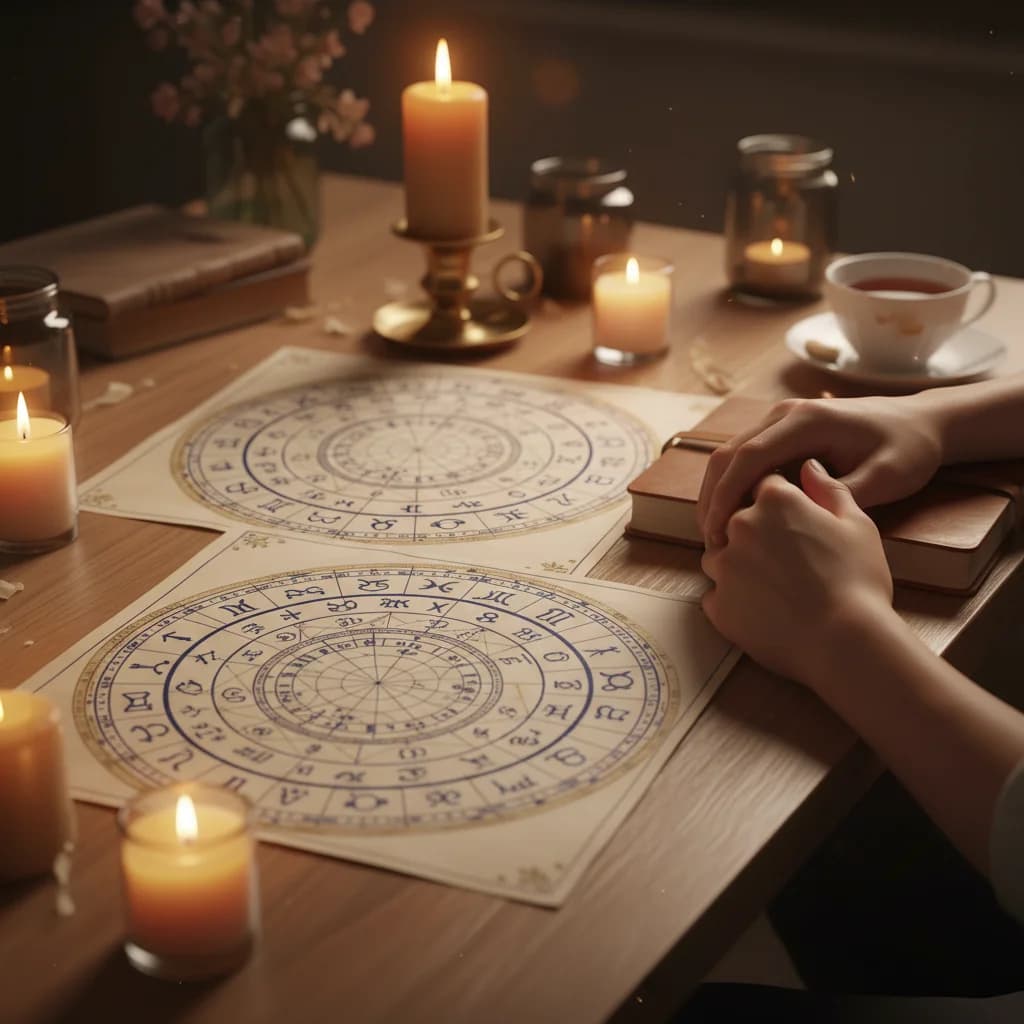
At its core, synastry is the astrological art of relationship analysis. It involves taking the birth charts of two individuals and overlaying them to see how their planetary placements interact. A birth chart is a snapshot of the sky at the exact moment and location of a person's birth, representing their unique psychological makeup, emotional needs, and life path. When you bring two charts together, you are essentially observing a cosmic conversation between two distinct personalities. Synastry does not simply dictate whether a relationship is "good" or "bad"; rather, it illuminates the specific areas where two people will naturally harmonize and where they will need to put in conscious effort to understand one another.
The mechanics of synastry rely heavily on planetary aspects, which are the mathematical angles formed between the planets in one person's chart and the planets in the other's. These angles describe the flow of energy between the two individuals. Harmonious aspects, such as trines (120 degrees) and sextiles (60 degrees), indicate areas of natural ease, mutual support, and shared values. Challenging aspects, like squares (90 degrees) and oppositions (180 degrees), point to areas of tension, differing needs, and potential conflict. However, in the realm of synastry, tension is not inherently negative. In fact, a certain amount of friction is often necessary to generate the initial spark of attraction and to keep the relationship dynamic and evolving over time.
To understand the nuances of a synastry reading, it is helpful to look at the specific planets involved in these interactions. While every planet plays a role, certain celestial bodies are particularly significant when evaluating romantic compatibility.
| Planet | Role in Synastry | Key Themes |
|---|---|---|
| Sun | Core identity and ego | Mutual respect, shared life direction, and basic compatibility. |
| Moon | Emotional needs and instincts | Emotional safety, domestic harmony, and intuitive understanding. |
| Venus | Love, values, and attraction | Romantic chemistry, shared aesthetics, and how affection is expressed. |
| Mars | Drive, passion, and conflict | Sexual attraction, physical energy, and how disagreements are handled. |
| Mercury | Communication and intellect | Mental rapport, conversational flow, and shared ideas. |
When analyzing a synastry chart, astrologers pay close attention to how these personal planets interact. For example, if Person A's Venus forms a harmonious trine to Person B's Mars, there is likely a strong, natural physical attraction and a complementary approach to romance and passion. Conversely, if Person A's Moon forms a challenging square to Person B's Saturn, Person A might feel that their emotional needs are restricted or judged by Person B, requiring conscious communication and patience to overcome.
Beyond planetary aspects, synastry also examines house overlays. The astrological houses represent different areas of life, such as career, home, partnerships, and hidden fears. When you overlay one person's chart onto another's, their planets will fall into specific houses in the partner's chart. This reveals the specific areas of life where the partner will have the most significant impact. If someone's Sun falls into your 7th House of Partnerships, they may feel like an ideal mate, naturally illuminating your desire for commitment. If their Jupiter falls into your 2nd House of Finances, they might bring abundance, optimism, or shared growth to your material resources.
Understanding these complex layers of interaction requires precision and a deep knowledge of astrological mechanics. Calculating a synastry chart by hand involves complex mathematics and a thorough understanding of planetary movements. Fortunately, modern technology has made this profound tool far more accessible. This is how astrology works, and by the way, this is exactly how our app calculates it for you.
Our platform utilizes the Swiss Ephemeris, the gold standard for astrological calculations, ensuring that every planetary position and aspect in your synastry chart is mapped with absolute mathematical precision. You do not need to be an expert to understand the dynamics of your relationships. The app automatically generates a comprehensive, AI-driven analysis of your compatibility, breaking down the complex interplay of your charts into clear, actionable insights. You can explore interactive maps of your shared planetary connections and receive a detailed portrait of your relationship's unique strengths and challenges.
Whether you are navigating a new romance, seeking to deepen a long-term partnership, or simply curious about the cosmic dynamics between you and a friend, synastry offers a profound lens through which to view your connections. It reminds us that relationships are not just random collisions of personality, but intricate dances of energy, mapped out in the stars long before we ever met.